Burnout shows up in the data first
Exit interviews are archaeology. By the time someone tells you why they are leaving, the reasons are six months old and the decision is a year old. The behavioural signature of burnout appears long before anyone says the word out loud, and it is quieter than most managers expect.
“Nobody announces burnout. It arrives as a schedule that slowly stops having edges.”
The resignation that was visible in March
A senior engineer at one of our customers, a 60-person fintech in Amsterdam, resigned in August. She was a high performer with no complaints on record, a fine last review, and a counter-offer she declined without hesitation. Leadership was blindsided, and the exit interview produced the usual polite fictions about a great opportunity elsewhere.
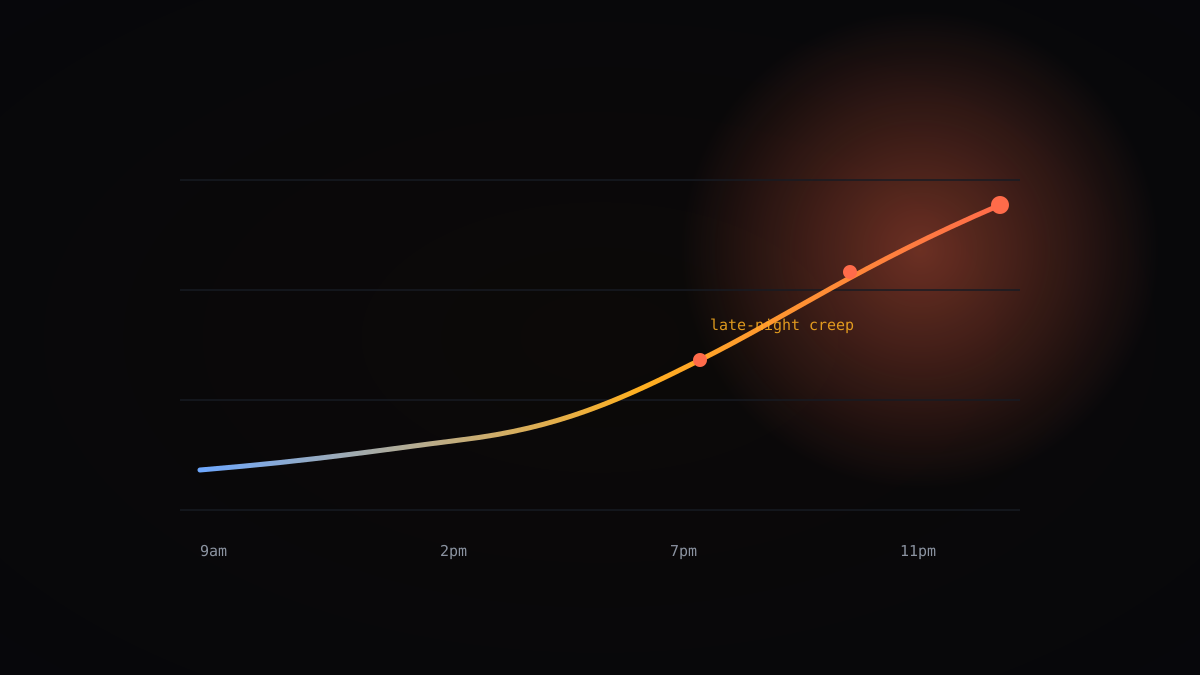
Her manager, retrospectively, was not. When he looked back at the team’s trend view, her pattern had bent in March. Evening activity that used to end by 6:30pm was stretching past 9. Her lunch gap, once a reliable 45 minutes, had compressed to under 15. Saturday logins went from rare to routine by May.
None of it was dramatic on any single day, which is exactly why nobody saw it. Each week looked like a slightly busy week. Only the six-month view showed the shape clearly, and by then she had already signed elsewhere. Burnout is not an event. It is a slope.
The creep works in fifteen-minute steps
The most reliable early indicator we see is elastic edges. Workdays do not suddenly become twelve hours; they lengthen by fifteen or twenty minutes a week, each step small enough to feel like a one-off. Someone answering messages at 7:15pm in January is answering them at 9:40pm by April and cannot tell you when the change happened.
The second signal is the death of recovery time. Breaks shrink before hours grow, in most of the cases we have studied. The person still leaves at a reasonable hour, but the day has become a single unbroken block, no lunch away from the screen, no gaps between meetings, no idle ten minutes.
A compressed day with no recovery is doing more damage than a long day with real pauses. Duration gets all the attention. Density does the harm.
Weekend logins are the loudest quiet signal
Occasional weekend work is normal and mostly harmless. The pattern to watch is regularisation: when Sunday activity appears three weekends in four, it has stopped being an exception and become load-bearing. The person is using the weekend to bail out a week that no longer holds its own water.
In our aggregate data, sustained weekend regularisation precedes either a resignation, a leave of absence or a serious performance dip within two quarters in a strong majority of cases. It is the single pattern we most encourage team leads to configure alerts for.
Note what the signal is not. It is not one heroic weekend before a launch, and it is not the founder who genuinely enjoys a quiet Sunday hour with a coffee and a roadmap. Healthy teams and healthy people spike and recover. The danger is the spike that never comes back down, because recovery is the thing burnout removes first.
Why the aggregate view still matters here
There is a tension in this article, and we should name it. Momentum is aggregate-first by conviction, yet burnout is an individual condition. The resolution is that the trigger should be aggregate and the response should be human.
Team-level trends tell a lead that after-hours activity is up 40% this quarter, or that average break time has halved since the reorganisation. That is a systemic finding demanding a systemic fix: workload, staffing, deadline hygiene. No individual conversation required, and often one person’s crisis is just the visible edge of a whole team’s slope.
Where a lead does have individual-level access under their organisation’s policy, the data justifies exactly one action: a conversation. Not a note in a file, not a performance flag. A question, asked early, by a human.
How to have the conversation without the dashboard
Do not open with the chart. Nobody wants to learn their employer graphed their exhaustion before asking about it. The data’s job was to prompt you weeks earlier than your intuition would have; its job is now done.
Open with observation and an offer. You have seemed stretched lately, and the workload conversation is one we can actually have. Then do the thing that makes the conversation credible: take something off their plate in the same meeting. Concern without capacity is just noise, and burnt-out people have finely tuned detectors for it.
One customer trains leads to end these check-ins with a concrete change, a deadline moved, a project reassigned, a Friday protected. Their voluntary attrition among flagged-then-supported employees runs at roughly a third of the rate of those whose patterns were noticed but never acted on.
The manager is in the data too
An uncomfortable finding from our customer base: team after-hours patterns correlate strongly with the lead’s own. Managers who send messages at 10pm create 10pm teams, whatever their stated policy says about not expecting replies. The behaviour is the policy.
The most effective intervention we have seen was also the cheapest. A director at a Singapore logistics firm noticed her own evening creep in her personal dashboard, moved to scheduled-send for anything after 6pm, and said nothing to anyone. Her team’s after-hours activity fell 23% in eight weeks without a single announcement.
Before configuring alerts for your team, look at your own trend line. It is frequently the source code.
A slope you can still walk back down
The hopeful part of all this is how reversible the early pattern is. In the cases we have tracked, people whose creep was caught within the first two months returned to baseline rhythms in four to six weeks once the load changed. Catch it after two quarters and the recovery takes far longer, if the person stays at all.
That asymmetry is the whole argument for measuring. Intuition catches burnout at the cliff edge. Data catches it at the first fifteen-minute step, when the fix is a project reshuffle rather than a counter-offer you will lose anyway.
Nobody resigns out of nowhere. They resign out of somewhere their manager was not looking. The information was there, quiet, weekly, and entirely legible. The only question is whether anyone was reading it early enough to matter.
drop in team after-hours activity within eight weeks of one director fixing her own evening habits
If you only remember four things
- Burnout arrives as a slope, not an event: fifteen-minute weekly extensions of the working day that nobody notices individually.
- Breaks shrink before hours grow; a dense day without recovery does more damage than a long day with real pauses.
- Weekend logins three weeks in four mean the weekend has become load-bearing, the strongest single early signal we track.
- Trigger on aggregate trends, respond with a human conversation, and take something off the person’s plate in the same meeting.
Writes for The Signal about leadership and the future of measurable, humane work — drawing on anonymised patterns from the teams and focus hours analysed on Momentum.
Want this picture for your teams?
See timelines, productivity scores, and department comparisons on your own data.
Book a demo