Managing the team you can’t see

When offices emptied, a lot of managers discovered that much of what they called management was actually observation: reading the room, noticing who looked stressed, catching problems in corridor conversations. Hybrid work removed the room. What remains is the job itself, and many people are doing it deliberately for the first time.
“Walking the floor was never management. It was surveillance with better manners.”
The shortcuts we lost
In a physical office, a manager absorbs enormous amounts of information without trying. Who arrives early. Who has stopped joining lunch. Whose desk conversations have turned tense. None of this was ever measured, but it fed a constant intuition about how the team was doing.
Hybrid removed the feed. A manager now sees a grid of cameras twice a day and a chat channel that shows only what people choose to type. The intuition keeps running, but on almost no data, which is how it starts inventing things.
We heard the same sentence from dozens of managers in 2023 and still hear it now: “I just don’t have a feel for the team any more.” They are describing a real loss. The mistake is trying to rebuild the old feed instead of building something better.
The trap of recreating the office
The instinctive response to lost visibility is to demand more of it: cameras on, status greens, daily written updates, tools that screenshot people’s laptops. Every one of these recreates the worst part of the office, being watched, while recovering none of the best part, being understood.
A 130-person insurance firm in Leeds tried the screenshot route in 2022 before coming to us. Within a quarter, their engaged employees had learnt to game the monitor and their best two engineers had resigned, both citing it in exit interviews. The data they gathered was worse than nothing, because everyone was performing for it.
Presence was always a terrible proxy for contribution. Hybrid just made the proxy unavailable, and grieving it is not a strategy.
The visibility demands also land unevenly. Parents, carers, and anyone in a distant timezone pay the highest price for green-dot theatre, because their most productive hours rarely overlap with the hours being watched. Several customers only discovered this pattern when their engagement surveys split cleanly along exactly those lines.
Manage the work, not the worker
The managers who adapted fastest made one mental shift: they stopped asking “what is this person doing right now?” and started asking “is the work healthy?” Those are profoundly different questions, and only the second one was ever really their job.
Healthy work has observable properties that need no camera. Commitments are met at a sustainable rate. Blockers surface early rather than at deadlines. Focus time exists and is trending stably. Collaboration happens in bursts rather than as a constant hum of after-hours pings.
Momentum’s team views show exactly these aggregate patterns, deliberately without a per-person live feed. When the Leeds firm switched approaches, their managers reported something unexpected: they understood their teams better than they had in the office, because the signal was now explicit instead of atmospheric.
Signals that replace the corridor
The corridor conversation had one genuine virtue: it caught trouble early. The hybrid replacement is trend data plus deliberate conversation. A team member whose focus hours have drifted down for a month, or whose activity has migrated into late evenings, is showing you the modern equivalent of looking exhausted at their desk.
One engineering manager we work with in Toronto keeps a Monday ritual: fifteen minutes with her team’s six-week trends before her one-on-ones. She is not looking for underperformance. She is looking for changes, because change is what corridors used to surface. Twice last year the pattern flagged someone quietly overloaded weeks before they said anything.
Managers sometimes worry this makes them slower than the corridor did. Our experience is the opposite. The corridor caught what happened to walk past you; the trends catch everything, including the quiet people the corridor always missed. The person in Warsaw who never came to the office, and never complained, gets noticed at exactly the same moment as everyone else.
The point is never the number. The point is that the number tells you where to spend your scarcest resource, which is attentive conversation.
Trust is a system property
People talk about trust in hybrid teams as if it were a personality trait managers either have or lack. In practice, trust is mostly produced by system design. Transparent measurement produces it. Secret measurement destroys it, regardless of how trusting the individual manager happens to be.
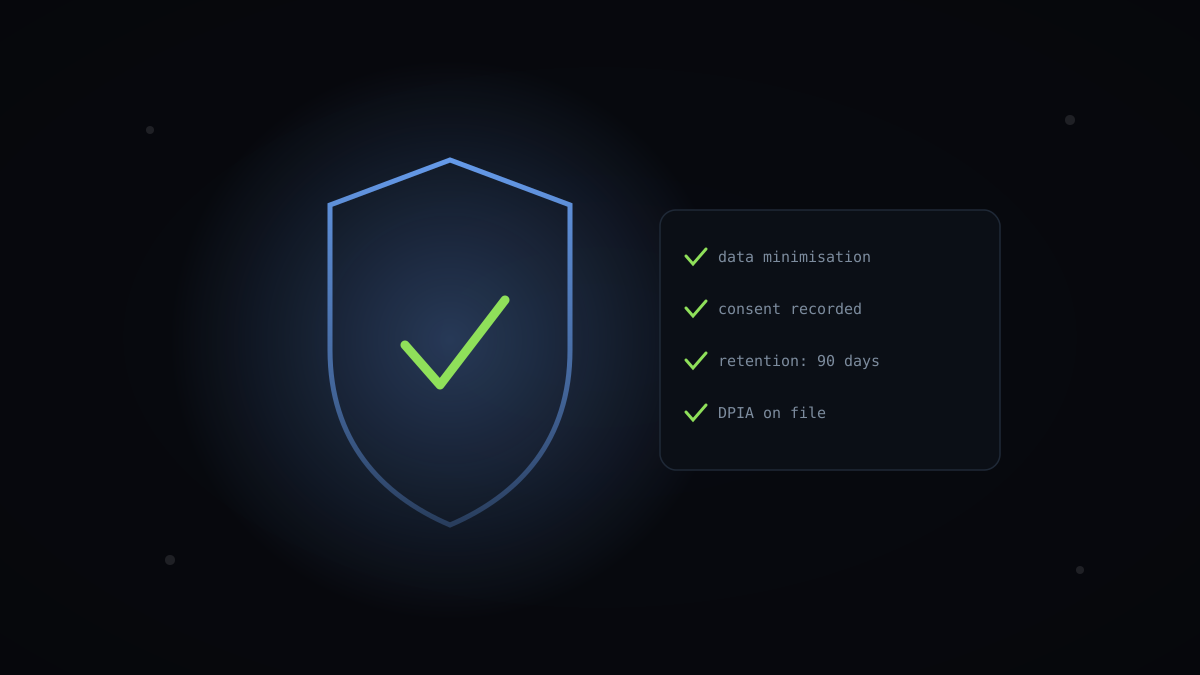
This is why Momentum’s agent is visible to the person running it, why employees see their own data first, and why individual-level views require the machine-approval workflow with the employee’s knowledge. Every one of those decisions costs us deals with buyers who want covert monitoring. We consider that a filter, not a cost.
The Leeds firm’s second attempt worked precisely because it was announced, explained, and inspectable. Same category of software, opposite outcome. The difference was consent.
Rhythm beats presence
Hybrid teams that thrive tend to share a strong weekly rhythm rather than strong attendance rules. A predictable cadence of planning, quiet days, and collaborative windows gives everyone the structure the office used to impose, without pretending geography is what mattered.
The aggregate data backs this up. In our customer base, teams with a designated no-meeting day show 22% longer median focus blocks across the whole week, not just on the quiet day. Rhythm compounds. Once people trust that depth time will exist, they stop defensively hoarding it in the margins.
Attendance intelligence has a role here too, but as a planning tool: knowing that Tuesdays and Thursdays are when the team overlaps in person lets managers put the high-bandwidth work there deliberately, instead of scattering it and hoping.
What good looks like now
A year into their second attempt, the Leeds managers described their job differently. Less patrolling, more gardening. They watch conditions, intervene where a trend says attention is needed, and otherwise leave capable adults alone to work. Regrettable attrition halved. Delivery predictability, their own metric, improved for five consecutive quarters.
New managers there now get trained on trends before they get direct reports, which struck us as exactly backwards from industry habit and exactly right in practice. Reading a team’s patterns is a learnable skill. Reading a room was always partly luck, and it never travelled beyond the room anyway.
None of this required seeing anyone. It required knowing what to look at instead.
Hybrid did managers an accidental favour. It took away the comfortable illusion that watching people work was the same as helping them work, and left behind the actual job. The managers who accept that trade are finding the job better than the one they lost.
longer median focus blocks all week on teams with one designated no-meeting day
If you only remember four things
- Presence was always a poor proxy for contribution; hybrid removed the proxy, not the ability to manage.
- Ask whether the work is healthy, not what a person is doing right now, and watch aggregate trends instead of live activity.
- Screenshot-style surveillance taught one 130-person firm’s best people to game the monitor and then to resign, citing it in exit interviews.
- Teams with a designated no-meeting day showed 22% longer median focus blocks across the entire week, not just the quiet day.
Writes for The Signal about remote and the future of measurable, humane work — drawing on anonymised patterns from the teams and focus hours analysed on Momentum.
Want this picture for your teams?
See timelines, productivity scores, and department comparisons on your own data.
Book a demo