What counts as work? The art of app classification
Every productivity number Momentum produces rests on one unglamorous foundation: a table that says which applications count as work, for whom. Get it wrong and your analytics are confidently misleading. We have helped thousands of teams build these tables, and the good ones share a philosophy more than a list.
“A classification table is not a list of apps. It is a statement about what your organisation believes work looks like.”
The video editor problem
The first classification dispute we ever mediated involved a 15-person creative agency in Bengaluru. Their default rules marked YouTube unproductive, which instantly scored the motion-design team as the least productive people in the building. They were watching reference footage. The account managers scrolling shorts at lunch, meanwhile, looked fine because Chrome was classified productive wholesale.
Both errors came from the same mistake: classifying the application instead of the role using it. A browser is not an activity. Neither, really, is YouTube, which hosts client review footage, competitor teardowns, tutorial libraries and an infinite supply of things that are none of those. Context is the unit of classification, and role is the best proxy for context we have.
This is why Momentum classifies per role, not per company. The video team’s YouTube is productive. The finance team’s is not. Nobody has to pretend otherwise in either direction, and the agency’s productivity numbers stopped insulting its most productive department within a week of the change.
Three buckets, honestly labelled
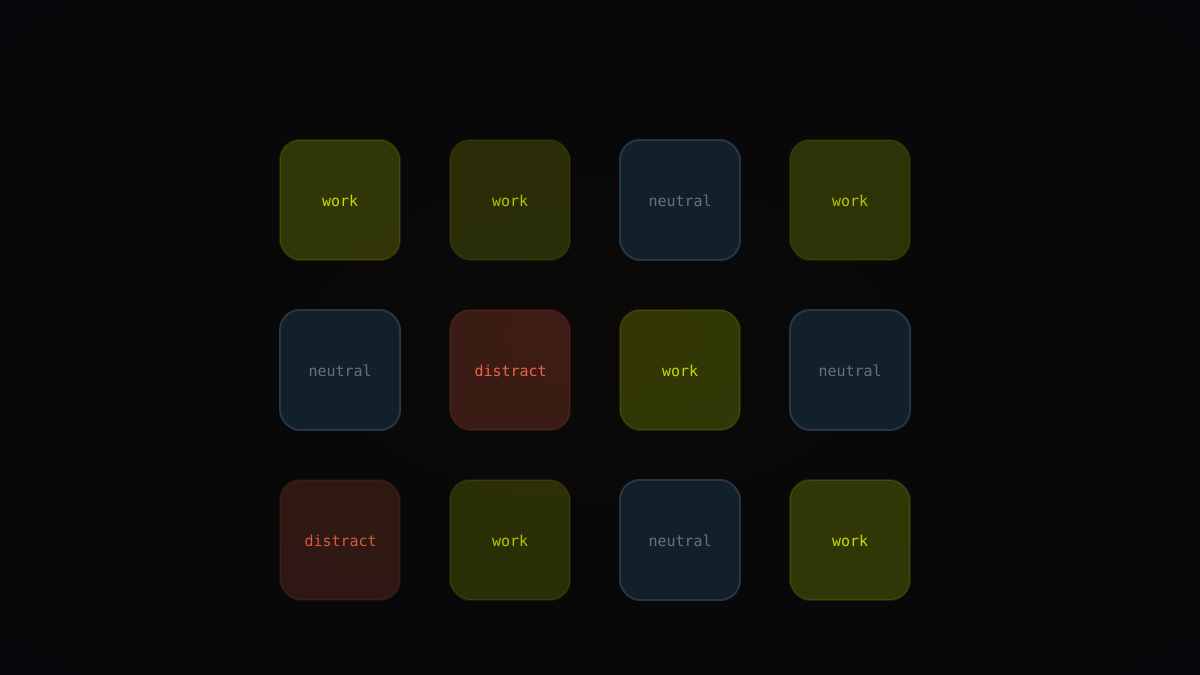
Productive means the tool is part of doing the job as this role defines it. Unproductive means it plainly is not, and the person would agree if asked in daylight. Neutral is everything you cannot honestly place, and it should be a big bucket, bigger than most administrators want.
Email is the classic neutral case. For a sales role it is the job. For an engineer it is often the thing preventing the job. We generally mark communication tools neutral for makers and productive for coordinators, then let the focus-scoring layer do the finer work of separating deep collaboration from reactive churn.
Resist the urge to force everything into productive or unproductive. A team whose day is 30% neutral is normal. A classification table with no neutral bucket is a table that is lying somewhere.
Write rules by role, review them with the role
Whoever owns the classification table should not finish it alone. The fastest route to a trusted setup is a thirty-minute session per team where people nominate their own tools. Engineers will tell you Stack Overflow and local documentation servers matter. Designers will claim Pinterest with a straight face, and for them it is true.
One operations director at a Manchester e-commerce firm ran these sessions as open workshops and finished with something unexpected: a team map of tools nobody knew were in use, including two unapproved data-sharing apps that went straight to the security team. Classification doubles as discovery.
When people write their own rules, they stop arguing with the scores. The number becomes theirs to explain rather than ours to defend, and the monthly review meetings shift from disputing the measurement to discussing the work. That shift is worth more than any accuracy improvement in the table itself.
The long tail and the machine
A 500-person organisation typically touches over 2,000 distinct applications and sites in a quarter. No human is classifying that tail by hand, and the tail matters: unclassified time erodes trust in every headline number sitting above it.
Momentum’s machine-approval workflow proposes classifications for new apps based on how similar roles have categorised them elsewhere, then queues each proposal for a human yes or no. Administrators typically clear a week of new apps in under ten minutes. The machine does the volume; a person keeps the judgement.
We deliberately do not auto-apply, even at high confidence, and customers occasionally ask us to change this. We decline. A suggestion accepted is a decision someone owns and can explain to the team it affects. A suggestion silently applied is a future dispute with nobody’s name on it.
Reclassify without ceremony
Classifications rot. Teams adopt tools, roles drift, a neutral app becomes central to a new workflow. If changing a label requires a committee, people stop requesting changes and start distrusting the data instead, quietly and permanently.
The healthiest setups we see treat reclassification like a pull request: anyone can propose, the team lead approves, the change is logged and takes effect from that date forward. Historical data stays scored under the old rule, so trends stay honest. One customer processes about a dozen such requests a month across 300 people. That cadence is a sign of life, not a problem.
Watch the request log, too, because it is an adoption signal hiding in an admin queue. When three teams independently ask to reclassify the same internal tool from neutral to productive, that tool’s owner has just learned something about real usage they would never get from a survey, and learned it months earlier.
Cases that will test your philosophy
Spotify divides rooms. We mark it neutral almost everywhere: music demonstrably helps some people focus, and its presence tells you nothing about output. Fighting over it costs more trust than any measurement gain is worth.
LinkedIn is genuinely hard. It is prospecting for sales, hiring for managers, and job-hunting for the disengaged, sometimes all in the same afternoon. We default it to productive for talent and sales roles and neutral elsewhere, and we advise customers not to pretend the ambiguity away. Some time will always resist labels.
ChatGPT and its siblings settled faster than we expected. By late 2025, nearly every customer had moved AI assistants to productive for knowledge roles. The classification debate lasted a year. The behaviour change was already done.
The table is the culture, written down
A classification table reveals what an organisation actually believes about work. Mark every non-work site unproductive and you have declared that presence equals value. Leave a generous neutral bucket and you have said you trust adults to manage their own texture of a day, and care mainly about the output patterns.
Our data suggests the trusting version wins on its own terms. Teams with collaboratively built classifications show measurably higher agent acceptance and richer, more honest data than teams handed a top-down list, because nobody routes around a system they helped write.
So take the setup week seriously, and revisit the table each quarter the way you would any other piece of infrastructure. It is the least glamorous part of the rollout, it will never appear in a case study, and it is the foundation for every insight that follows.
distinct apps and sites a 500-person organisation touches in a quarter
If you only remember four things
- Classify by role, not by application; YouTube is core tooling for a video editor and a distraction for an accountant.
- Keep a generous neutral bucket, because a table with no honest middle is misleading somewhere.
- Let each team nominate its own tools in a thirty-minute workshop so people stop arguing with their own scores.
- Use machine-approval to propose labels for the long tail, but never auto-apply; every classification needs an owner.
Writes for The Signal about playbook and the future of measurable, humane work — drawing on anonymised patterns from the teams and focus hours analysed on Momentum.
Want this picture for your teams?
See timelines, productivity scores, and department comparisons on your own data.
Book a demo